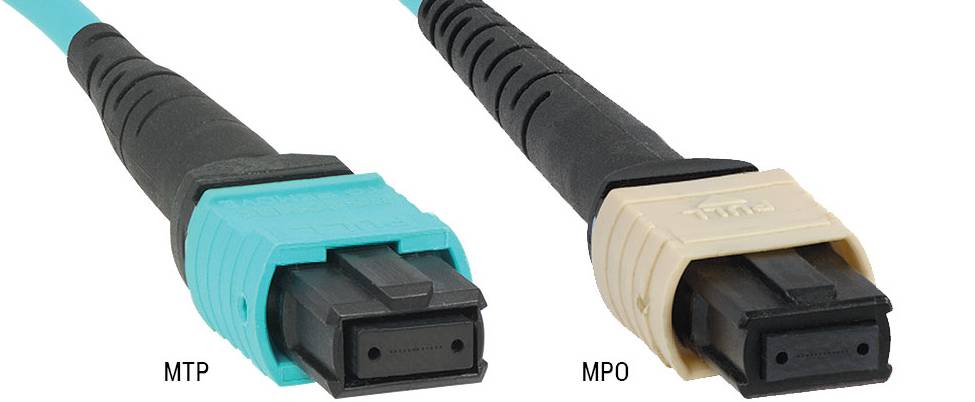
Many people are interested in which cable is better to choose MPO or MPT. On the one hand, the MPO is a global standard, and on the other hand, why not choose the best version? So we will consider MPO vs MTP . How are they different and which one is the best?
What Are MPO and MTP Cables?
Well, first consider what is MPO and MTP cable. An MPO or as it is called (Multi-Fiber Push-On) cable is an optical connector with an MT (Mechanical Transfer) multi-fiber ferrule that has holes for multiple optical fibers (usually 12 or 24). MPO cables allow simultaneous connection of several optical communication channels, therefore they are used in systems of parallel data transmission, as well as in networks with numerous connections (for example, SCS of data centers).
MPO cables could be of one or two types: Male and Female. Let’s understand what this means. The Male connector has two guide pins protruding from the tip. In this case, it will be the opposite. The Female connector has holes for these pins.
The MTP (Mechanical Transfer Push-On) connector is the same MPO cable but much improved and developed by US Conec. The MTP has many design differences from the standard MPO that reduce insertion loss and increase the mechanical strength and durability of the connector. Also, the MTP cable has a collapsible body that allows you to change the type of connector (Male-Female).
MTP vs MPO: Mechanical designs
MPO and MPT the differences of the connector. Since the MPT is an improved version of the MPO, it is known that it has improved mechanical and optical characteristics. Let’s start with a pin clamp, one of the characteristics of mechanical features. MPT is considered better than MPO because it has a metal clamp. In turn, MPO has less reliable plastic clamps. With a plastic clamp, the permanent connection of cables can break the pins, while the metal clamp will be able to provide a strong clasp and a minimum percentage of gaps in the connections. For additional reliability for cables, MPT began to produce an oval spring. This extra feature helps do not damage the cable.
Next, we will consider the floating ferrule. It is also equipped with an MPT cable. MPO cable does not have such a property. This provides a connection to the active Tx / Rx device. Therefore, it is impossible to do this with an MPO cable.
Guide pins are also part of mechanical design. There are some differences between MTP vs MPO. In this case, these cables are also different. The chamfer is used for connection in an MPO. Unlike the MTP, which has elliptical pins, they create a lot of debris. The last characteristic is the replaceable case. It’s only in the cable. With this you can get such additional features as polish the MT tip, you can also easily change the type (gender) of the tip or, for example, if you need to access performance testing.
MTP vs MPO: Optical Performance
MTP MPO has a difference in optical performance. Advanced MTP cables deal with the loss of optics, lost packets or others. During the data transmission process with high-density cables using the MTP cable, you can reduce insertion losses and return losses to a minimum. MTP cables also provide greater reliability of a stable signal.
Future Trends of MTP Cables
Even though MPO cables have become the world standard, MPT cables have become their more functional and reliable version. The cable can even be used in different environments. Therefore, using the cable at different temperatures or humidity will not be a problem. MPT cables are becoming more and more improved and interconnected with various areas, such as financial, educational, and others.